
AI AI-00.02
A short history of AI
From Turing's question and the Dartmouth workshop through expert systems, two AI winters and deep learning to transformers and large language models.
The big idea
AI is not new. People have been building "thinking machines" since the 1950s, and the field has swung between wild optimism and deep disappointment several times. Periods of hype brought money and bold promises; when the promises were not kept, funding dried up in what became known as AI wintersA period when interest and funding for AI research collapsed after expectations were not met. The main ones were in the mid 1970s and the late 1980s to early 1990s.. Each comeback was powered by a different idea: logic and search, then expert systems, then statistics, then deep neural networks.
Knowing this history is practical, not nostalgic. Many of today's techniques are old ideas that finally got enough data and computing power. And the pattern of over-promising followed by a correction is worth recognizing when you read headlines about AI today.
How it works
Step 1: The shape of seventy years
Step 2: The symbolic era (1950s to 1980s)
In 1950 Alan Turing asked "Can machines think?" and proposed the imitation game, now called the Turing testTuring's proposal to judge machine intelligence by whether a person conversing in text can tell the machine from a human.. In the summer of 1956, a workshop at Dartmouth College gave the field its name, and its organizers believed key problems could be solved quickly.
Early AI was symbolic: intelligence as manipulating symbols with logic and search. Programs proved theorems, played checkers and solved puzzles. At the same time, Frank Rosenblatt built the perceptron, a machine that learned from examples, an ancestor of today's neural networks:
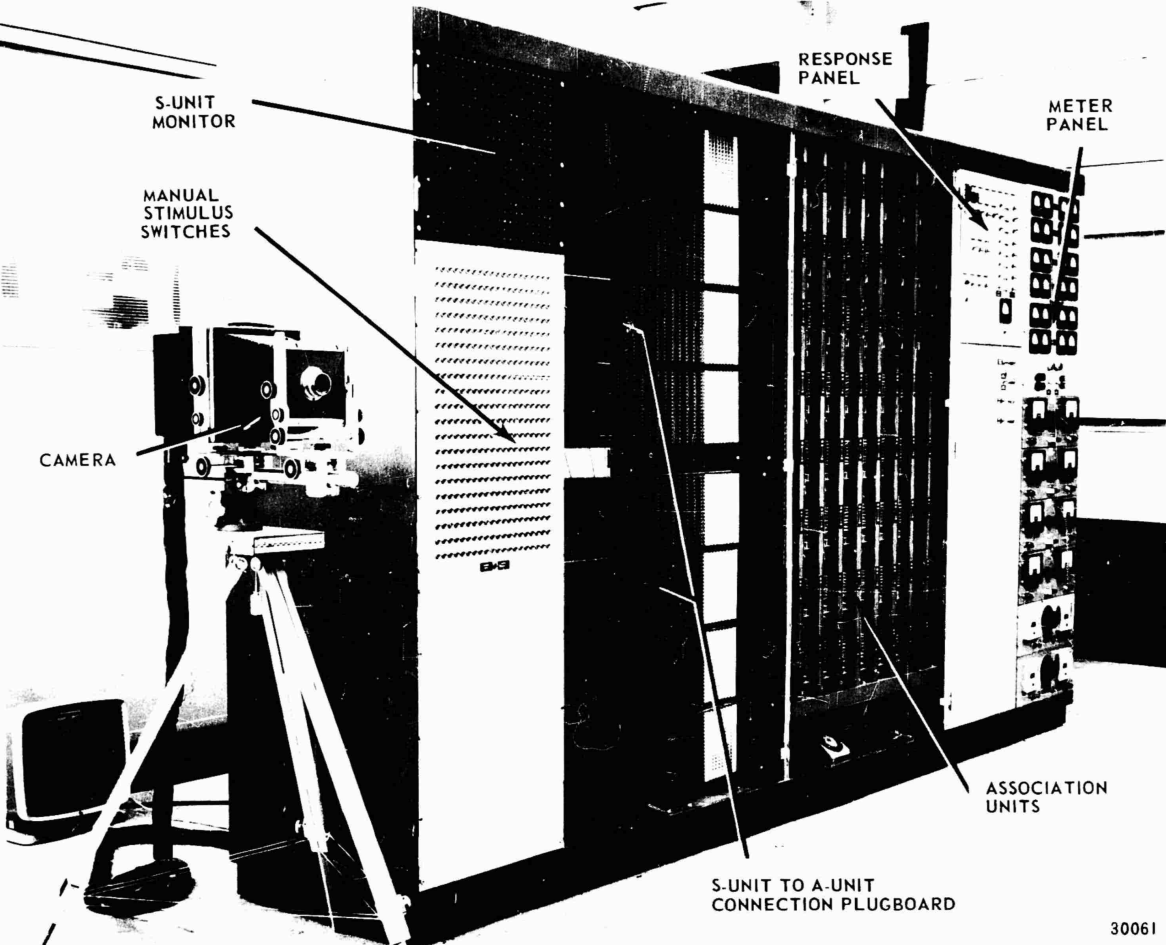

Progress was real but much slower than promised. A single-layer perceptron provably cannot learn some simple patterns, critical reports questioned what had been delivered, and in the 1970s funding fell sharply: the first winter. In the 1980s expert systemsPrograms that encode a human expert's knowledge as many if-then rules to give advice in a narrow domain, such as diagnosing infections or configuring computers. brought a second boom. Companies built rule-based advisors for narrow jobs, but the rules were costly to write, brittle and hard to maintain. By the late 1980s the market collapsed: the second winter.
Step 3: The statistical turn (1990s to 2000s)
Researchers increasingly let data do the work. Probabilistic models, decision trees and support vector machines learned from examples and handled uncertainty better than hand-written rules. In 1997 IBM's Deep Blue beat world chess champion Garry Kasparov, using massive search rather than learning. Through the 2000s, machine learning quietly took over spam filtering, search ranking, recommendations and fraud detection.
Step 4: Deep learning and the LLM era (2012 onward)
Neural networks with many layers had existed for decades, but needed more data and computing power than anyone had. In 2012 a deep network called AlexNet, trained on graphics cards, won the ImageNet image recognition challenge by a wide margin, and the deep learning boom began. In 2016 DeepMind's AlphaGo beat Lee Sedol, one of the world's best Go players, a game long considered too intuitive for computers. In 2017 the paper "Attention Is All You Need" introduced the transformerA neural network architecture built on attention, which lets every token look at every other token. It is the basis of modern large language models., which turned out to scale remarkably well. Larger and larger language models followed, and the public release of ChatGPT in late 2022 brought generative AI to hundreds of millions of people.
Try it
Try this:
- Open the two winter cards. What did each boom promise that it could not deliver?
- Find the milestones that rely on search and those that rely on learning. Which one combines both?
- Pick a claim about AI from this week's news. Which era's promises does it sound like?
Going deeper
Old ideas, new scale
Neural networks, backpropagation and even attention-like mechanisms existed long before they dominated. What changed after 2012 was scale: far more data from the internet, far more computing power from GPUs, and engineering tricks that made deep networks trainable. That is a recurring theme: an idea can be right decades before the resources exist to prove it. The ML track tells the neural network side of the story in The perceptron and the artificial neuron .
Search never went away
Symbolic AI's tools are not obsolete. Search, logic and planning run map routing, game engines, compilers, schedulers and the verification of chips and software. Modern agents often combine a language model with classical search and planning. The first half of this track, starting at Agents and environments , covers these ideas.
Trade-offs
| Option | Wins when | Loses when |
|---|---|---|
| Symbolic AI (rules, logic, search) | Problems with clear rules: exact, explainable, needs no training data | Perception and language, where the rules cannot be written down |
| Statistical machine learning | Structured data with many labelled examples: fraud, ranking, forecasting | Raw images, audio and text, where hand-made features fall short |
| Deep learning and LLMs | Perception, language and generation at scale | Cost, data needs, guaranteed correctness and explainability |
Common mistakes
- Believing AI started with ChatGPT. Most core ideas are decades old.
- Reading history as a straight line of progress. It went through booms and collapses driven by over-promising.
- Assuming the newest approach replaced everything before it. Classical methods still do much of the work in real systems.
- Treating a milestone in one game or benchmark as general intelligence. Each was impressive and narrow.
Check yourself
-
What was the Dartmouth workshop of 1956 known for?
Show answer
B. Naming the field of artificial intelligence The 1956 workshop gave the field its name and launched it as a research area.
-
What caused the AI winters?
Show answer
B. Results fell far short of promises, so funding collapsed Over-optimistic predictions met hard limits, and funders pulled back.
-
Which 2012 event started the deep learning boom?
Show answer
B. AlexNet winning the ImageNet challenge A deep convolutional network trained on GPUs beat other methods by a wide margin on ImageNet.
-
Which milestone combined deep learning with tree search?
Show answer
C. AlphaGo AlphaGo used neural networks to evaluate positions and guide a tree search.
Recap
- AI began in the 1950s with Turing's question and the 1956 Dartmouth workshop.
- Symbolic AI and expert systems each brought a boom, followed by an AI winter.
- Statistical machine learning took over practical tasks in the 1990s and 2000s.
- Deep learning broke through in 2012; transformers (2017) led to today's large language models.
- Many modern techniques are old ideas that finally got enough data and compute.
Next up
- I know nothing yet learning path